There is a tell, if you know what to look for. It shows up in language first — in the almost apologetic way a job title changes without the job itself changing. Marketing becomes “growth engineer.” Customer service and sales become “forward deployed.” And suddenly, everywhere, you are encountering roles like “GTM engineer,” “senior branding engineer,” “UGC engineer” — titles whose actual responsibilities, when you read the fine print, involve content strategy, creator management, targeted outreach, and marketing asset coordination. The same work. A different name. And the name is doing something.
This is the observation that brand consultant Miranda Shanahan made in a TikTok that reached over a million views, and it landed because it named something many people had been sensing without quite articulating: that these new titles are designed to read as technical, intellectual, serious — and, not incidentally, more legible to a workforce that has long associated those adjectives with men.
The instinct to wave this off is understandable. The history that makes it impossible is not.
The Precedent
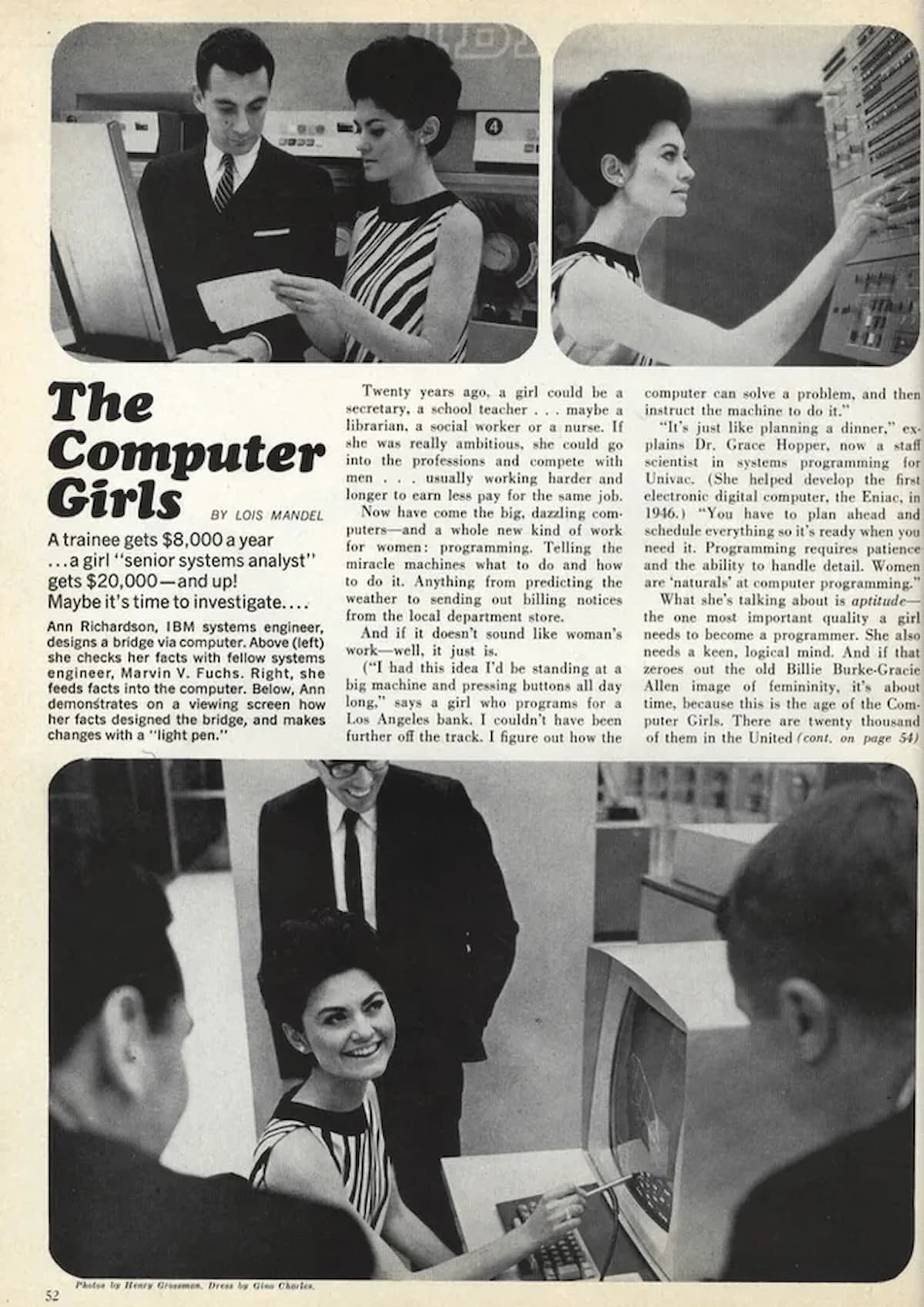
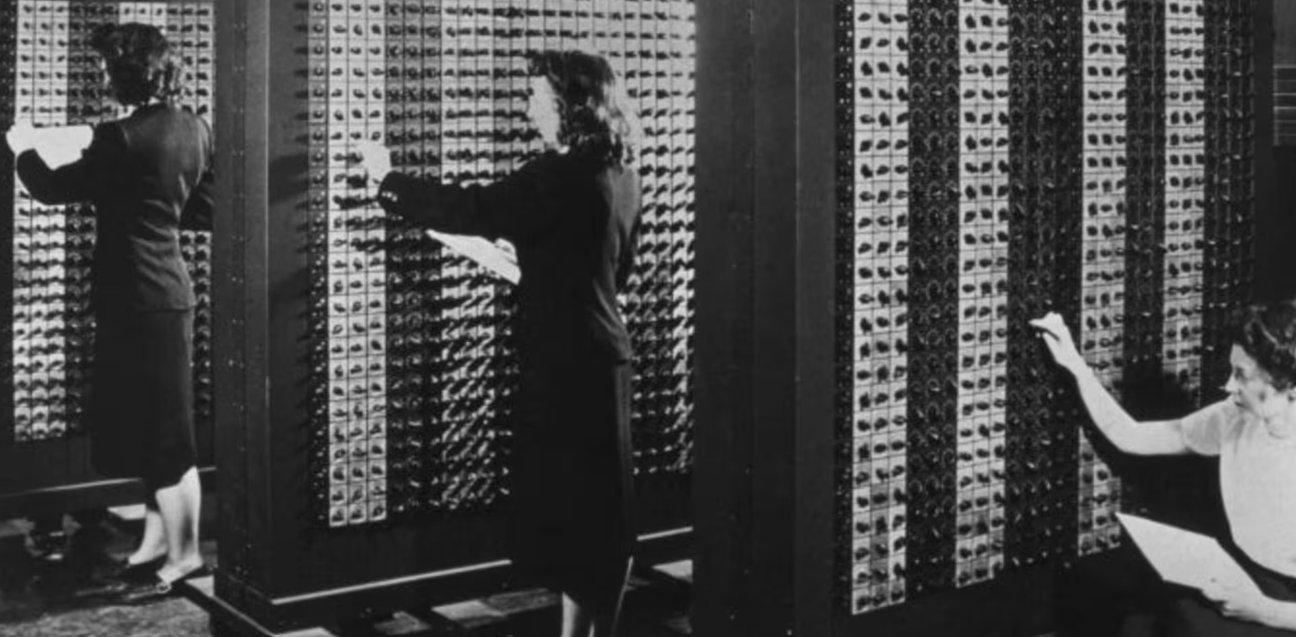
In the early 1940s, computing was women’s work. Not metaphorically — literally. With men fighting overseas, the women who staffed government calculation offices during World War II were called “computers,” a job title that described a function: the manual processing of numerical data. Programming, when it emerged, was treated as an extension of this clerical tradition. Making software was secondary to making hardware. Hardware was the province of male engineers; software was the province of women who, as one 1940s engineering assessment noted approvingly, were more patient and less prone to error. The compliment was also a containment strategy.
The field grew. Women’s participation grew with it. By the mid-1960s, women held between 30% and 50% of computer programming jobs in the United States. The share of women pursuing computer science degrees climbed steadily through the 1970s and into the early 1980s, peaking at 37.1% of all computer and information science bachelor’s degrees in the 1983–84 academic year.
And then, almost exactly at that peak, the numbers reversed.
What happened? The personal computer arrived, and it arrived as a boys’ toy. It was marketed that way, sold that way, gifted that way — boys were more than twice as likely as girls to receive a home computer as a gift. The cultural image of the programmer shifted from clerical specialist to basement prodigy, and the basement prodigy was invariably male. By the late 1980s, arriving in a computer science program without prior home computing experience put students at a disadvantage, and that disadvantage was not distributed equally. The field didn’t formally exclude women. It didn’t have to. The cultural environment did the work.
Shanahan’s summary of this arc is precise enough to be worth quoting directly: “Software was feminized when it was considered clerical, masculinized when it became high status.”
Why Now
The mechanism driving today’s rebrand is not mysterious. For the better part of two decades, the most valued skill in the technology industry was writing software. Coders were the scarce resource; everything else was support staff. That hierarchy is shifting.
As LLMs make basic software development increasingly accessible — lowering the floor of who can build a functional tool or automate a workflow — the constraint is moving elsewhere. It is moving toward distribution: the work of figuring out who needs what a company makes, how to reach them, and how to earn their trust and convert their attention into action. This is, in essence, what marketing has always been. The fact that it now involves data infrastructure and automation tools doesn’t change its fundamental purpose. It does, however, change its perceived status. And when perceived status rises, the titles follow.
The Chief of Staff offers a useful example — and one that predates AI entirely. The role — coordinating a leader’s priorities, managing information flow, ensuring that decisions get made and executed — is functionally what the executive assistant has always done. The rebrand arrived in tech roughly a decade ago, when former government officials brought the vocabulary to Silicon Valley with them. The title borrowed its gravity from military and political tradition, both institutions with deep associations with male authority. Whether consciously or not, the rebranding of “executive assistant” to “Chief of Staff” followed the same logic now being applied to “marketer” and “growth engineer”: cloak the work in language that signals strategic weight, and it reads differently.
The Counterargument
The counterargument is worth taking seriously on its own terms. Julia Pintar, who has claimed credit for coining the term “UGC engineer,” put it this way: “The nomenclature gives these roles the integrity that they deserve.” Others have noted, correctly, that the actual work has changed — that modern marketing does require fluency in analytics platforms, automation tools, and increasingly, the ability to build or at least configure technical systems. When the job changes, the title should change.
This is a fair point. It is also not a complete one. The question is not whether the work has changed — it has — but whether “engineer” is the right word for what changed, or whether it is the highest-status word available, chosen partly for what it signals about who should do the job. These are not mutually exclusive. Both can be simultaneously true: the role has genuinely evolved, and the language chosen to describe that evolution is doing social work that goes beyond accuracy.
Research supports this. A study published in the Journal of Personality and Social Psychology found that when job advertisements used more masculine-coded language, women found the positions less appealing — not because they doubted their own skills, but because the language signaled that they didn’t belong. The barrier was not competence. It was the ambient message about who the role was for. Job titles transmit that message before a single qualification is listed.
The Gap
As of 2023, only 16% of engineers in the United States were women. Marketing, by contrast, is 60% female — a figure drawn from LinkedIn data published by the American Marketing Association.
These two fields are now being linguistically merged, with marketing’s vocabulary moving decisively toward engineering’s. Whether or not that is anyone’s explicit intention, the effect has historical precedent. And the precedent is not encouraging.
The decline of women in computing did not happen through policy or prohibition. It happened through culture, through language, through product marketing that told one group of children this was for them and another group that it wasn’t. The professional consequence of that ambient messaging took decades to manifest and has still not been reversed.
What We’re Really Watching
There is a version of this story in which the rebranding is straightforward: the work is more technical now, the titles should reflect that, and elevated compensation and status will attract people who might not have considered these roles. That version has merit. It does not have the full picture.
The pattern of who benefits when a field’s status rises has been consistent enough across industries and across time to warrant more than assumption. Historians of computing have made this argument explicitly: professionalization tends to masculinize. Once a discipline becomes worth doing in the eyes of institutions and capital, it acquires the cultural markings of the people those institutions have historically valued most.
The rebranding will continue. Status and compensation have to keep pace with where value is accruing; that is not a moral failure, it is how labor markets work. But keeping pace does not require the vocabulary of a field that is 84% male. It requires, at minimum, honesty about what the work is — and enough self-awareness to recognize that the signals language sends are not neutral.
Miranda Shanahan’s TikTok went viral because it named something recognizable. The more important question is whether recognition leads anywhere. We have done this before, with software. We called it the future. We called it progress then too.